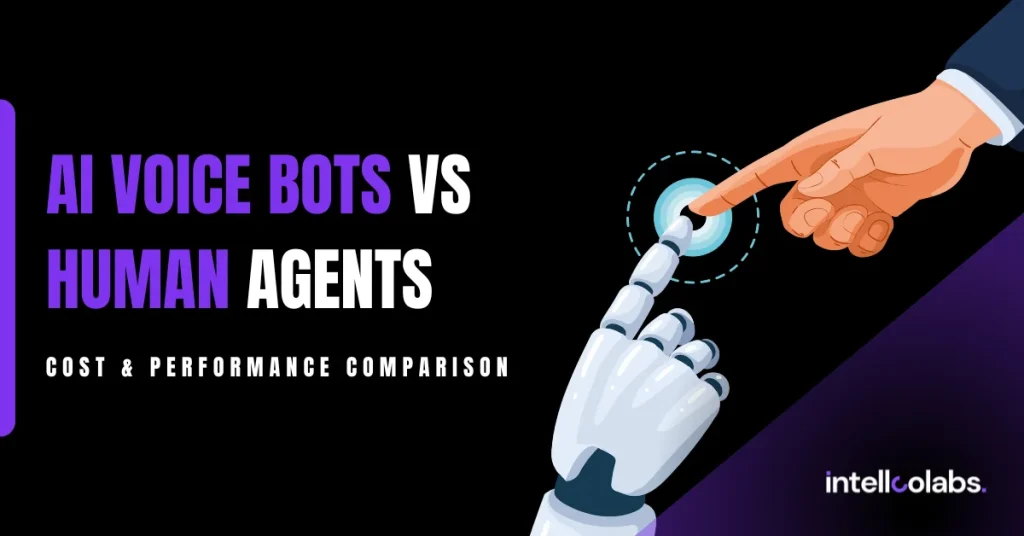
For decades, human agents have been at the core of customer service and outbound communication. Whether answering product questions, confirming appointments, or handling escalations, human representatives have long been considered essential to maintaining brand trust and operational efficiency.
But today, the equation is changing. Large language models and synthetic voice technologies are giving rise to AI-powered voice bots that can perform many of the same functions as humans—faster, cheaper, and with unlimited scale.
What was once a bold experiment in automation is now a serious operational choice. Businesses that adopt AI voice bots are not simply reducing headcount. They are rethinking the very structure of how communication, support, and outreach happen at scale.
The question is no longer “Can AI replace agents?” but “In what scenarios does it perform better—and how does the ROI compare?”
Let’s break it down by cost, performance, scalability, and real-world impact.
The Cost of Human Agents vs AI Voice Bots
Let’s start with what every CFO cares about first: cost per seat.
A typical customer service or outbound sales agent in the US earns between $30,000 and $50,000 per year. Add recruitment, training, software licenses, HR overhead, and productivity losses from turnover, and you’re looking at a true cost of roughly $4,000 to $5,500 per agent per month.
AI voice bots, on the other hand, operate on a usage-based or subscription model. Leading platforms like Retell AI, Vapi AI, and custom GPT-based agents can operate at a per-minute rate ranging from $0.05 to $0.20. For an agent making 3,000 minutes of calls per month (about 100 minutes a day), that comes out to $150 to $600 total.
Here’s a comparison of total cost per month per “agent” equivalent:
| Cost Category | Human Agent | AI Voice Bot |
|---|---|---|
| Salary | $3,500 | N/A |
| Training & Onboarding | $400 | $50 (initial setup) |
| Software & Tools | $300 | $200 – $300 (platform fee depending on usage) |
| Infrastructure (office, HR) | $200 | $0 |
| Total Cost per Month | ~$4,400 | ~$500 (avg usage) |
The cost differential becomes exponential when scaled across 100 or 1,000 agents.
Performance Metrics That Matter
Of course, cost is only part of the equation. What about quality?
Performance can be measured by several dimensions: speed, accuracy, consistency, availability, and customer satisfaction. Here’s how AI stacks up against humans.
| Metric | Human Agent | AI Voice Bot |
|---|---|---|
| Calls handled/hour | 8 to 20 | 100+ (simultaneous conversations) |
| Availability | 9-to-5 or shift-based | 24/7, including holidays |
| Response time | 10–60 seconds | <1 second |
| Multilingual support | Often limited | Native support across 50+ languages |
| Accuracy (after training) | ~85–90% | ~90–95% (with retrieval support) |
| Consistency | Varies with stress/fatigue | Constant performance |
| Fatigue/Error Rate | Increases over shift | Zero impact |
| Escalation handling | Empathetic, flexible | Requires fallback or hybrid setup |
AI doesn’t get tired. It doesn’t take breaks. And it doesn’t forget brand guidelines or compliance scripts. With retrieval-augmented generation (RAG) and vector memory, it can instantly surface the right answer from internal documentation or policy databases.
However, AI still struggles in emotional nuance. For high-empathy, complex scenarios—like handling a bereaved customer or negotiating contract exceptions—humans remain superior. And that’s okay. The objective is not to replace humans but to reallocate them to where they are uniquely valuable.
Scalability and Speed to Deployment
Hiring and training 50 new agents can take months. Each needs onboarding, supervision, and management. Attrition is high—especially in call centers, where annual churn rates can exceed 30 percent.
In contrast, deploying 50 additional AI voice bots is a matter of server provisioning. You configure the campaign logic, ensure compliance settings, and scale immediately. No interviews. No burnout.
This kind of instant scalability is mission-critical in scenarios like:
- Product launches with sudden traffic surges
- Crisis management or product recalls
- Seasonal demand (e.g., Black Friday support)
According to Gartner, companies that implement conversational AI for customer operations can scale support volume by 3 to 5 times without increasing headcount.
Security, Compliance, and Risk
Human agents, while trained, are subject to inconsistency. They can inadvertently share sensitive information or fail to follow protocols. They are also a liability for data leaks if systems are not properly segmented.
AI voice bots can be programmed to redact PII, anonymize records, and never deviate from compliance scripts. Encryption and audit trails ensure every conversation is traceable. However, initial setup must include training for industry-specific laws—HIPAA, GDPR, TCPA, or PCI-DSS.
In high-risk industries like healthcare or banking, AI adoption is rising precisely because of this control. But it comes with responsibility. Training and monitoring are still essential, especially as hallucination risks persist in some generative models.
Use Case Fit: Where AI Performs Best
AI voice bots are ideal for:
- Appointment reminders and confirmations
- Cold call lead qualification
- FAQs and tier-1 support tickets
- Follow-up surveys and feedback collection
- Payment reminders or renewal alerts
These are repetitive, high-volume, and often low-emotion interactions where speed, accuracy, and cost matter more than empathy or negotiation.
Humans are better suited for:
- Handling emotionally sensitive customers
- Crisis or escalation management
- Complex B2B negotiations or legal contracts
- Sales requiring persuasion and nuance
This suggests a hybrid approach, not a full replacement.
Hybrid Models Deliver the Best of Both Worlds
The most successful companies don’t view this as a binary decision. They use AI voice bots as the first line of engagement and escalate to human agents when needed.
Here’s a common example:
- AI agent greets the customer, verifies identity, and gathers the issue
- If the request is routine (e.g., “I want to know my balance”), AI completes it
- If the issue is complex (“I was charged incorrectly”), the AI transfers the call with a transcript summary to a human
This hybrid model improves first-response time, reduces average handle time (AHT), and allows human agents to focus on high-value work.
It’s not about cost-cutting. It’s about productivity.
Return on Investment (ROI)
Let’s consider a practical ROI scenario. A company with a 20-person support team spends approximately $80,000/month on salaries and tools. If 60 percent of their inquiries are tier-1 (routine), and AI bots handle those at one-tenth the cost, the company could save $25,000–$30,000 per month while improving speed and availability.
Beyond hard savings, the business benefits include:
- Faster response times → higher CSAT scores
- 24/7 coverage → increased retention and NPS
- Scale capacity during peak loads → revenue protection
- Detailed logs and analytics → better QA and training
McKinsey projects that AI can reduce customer service costs by up to 40 percent by 2030 while simultaneously increasing customer satisfaction by up to 15 percent.
This is not future theory. It’s present practice.
A Word of Caution
AI is not plug-and-play. Poorly configured voice bots can frustrate users and damage trust. Successful deployment requires:
- Clear conversation design and fallback logic
- Integration with CRM and helpdesk systems
- Human supervision, especially in early stages
- Continuous monitoring of transcripts and outcomes
The best companies treat AI bots as digital employees: they are hired, trained, measured, and improved over time.
Final Thoughts
AI voice bots are not coming for human jobs. They are coming for human inefficiency.
They are the answer to overworked support teams, missed leads, long wait times, and rising costs. When deployed strategically, they unlock a multiplier effect. You don’t just save money. You create better customer experiences, faster responses, and a foundation for true operational scale.
This is the moment to rethink how you engage with customers at voice level. Not by choosing between humans and AI, but by aligning each with their strengths.
Let your humans do what only humans can. Let your AI handle the rest. The result isn’t just cost efficiency. It’s performance at a scale that was previously impossible. And it’s already happening. The future is calling. Now it speaks in your brand’s voice.